

A DISTILLERY
FULL OF MEMORIES
THIS IS A DISTILLERY BORN OF AMBITION

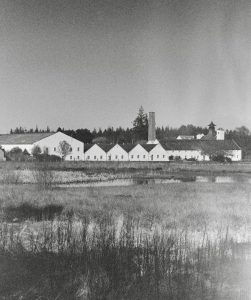
Dallas Dhu was founded at the end of the 19th century, a time when Scotland’s whisky industry was booming. Local entrepreneur Alexander Edward, already behind several whisky and tourism ventures in and around Forres, built two new distilleries in 1898: Benromach and Dallasmore. Before Dallasmore had even gone into production, it was sold to whisky blenders, Wright & Greig of Glasgow, who needed a steady supply of malt for its best-selling Roderick Dhu blend. To mark the connection the distillery was renamed Dallas Dhu Distillery in 1899.



A DISTILLERY WITH A CHEQUERED PAST
Dallas Dhu’s story is one of resilience. The distillery filled its first cask on 3 June 1899, but within a few years, it faced its first major challenge — closure during the First World War. Ownership passed through different hands, from J.P. O’Brien & Co. Ltd to Benmore Distilleries, each bringing investment but also instability. The distillery was forced to close during the economic crash of the early 1930s, and just as it reopened in 1939, disaster struck again when a fire tore through the buildings.
Production restarted after the Second World War, and Dallas Dhu carried on for several decades, turning out the traditional Speyside malt whisky it had become known for. But in 1983, after years of falling demand, excess stock across the industry, and an unreliable local water supply, the final cask was filled and the distillery went silent.


THE LIFE OF A DISTILLERY WORKER
Though small compared to the giant distilleries of today, Dallas Dhu was a hive of activity. Around fifteen men typically worked on site, their roles spanning manager, brewer, maltman, mashman, stillman, warehouseman and cooper. Each group was led by a skilled head man, but in reality everyone turned their hand to whatever was needed, rolling barrels, shovelling peat or unloading barley.
The one man who stood apart was her majesty’s custom and exciseman, an officer from Customs and Excise charged with monitoring every drop of spirit made. Dallas Dhu’s most famous exciseman was Maurice Walsh, the Irish author best known for The Quiet Man, later adapted into the Hollywood film starring John Wayne and Maureen O’Hara. His presence adds a literary twist to the distillery’s history.
Another influential figure in the story of Dallas Dhu is Charles Doig, the renowned distillery architect responsible for its design. His distinctive creation, often mistakenly called a pagoda, is more accurately known as a Doig ventilator. Far from decorative, it was an efficient and practical solution, designed to draw peat smoke away from the fires used to dry malted barley below.
Today, with only a small number of distilleries still malting their own barley on site, many of these structures are no longer in use. Even so, the familiar pagoda-style roof remains a powerful visual reminder of an earlier era of Scotch whisky making.

A PRESERVED TIME CAPSULE
What makes Dallas Dhu extraordinary is how little it has changed. While other distilleries modernised, Dallas Dhu Distillery has remained frozen in time — making it one of the most complete examples of an early 20th-century malt distillery still in existence.
Today, visitors can:
- Walk through history — explore the still house, warehouses and maltings much as workers once thrived.
- Step into the stories — hear about the lives, skills and traditions of the people who kept the distillery running.
- Feel the craft — imagine the heat, the graft and the aroma of whisky-making in its original setting.
And now, with whisky production returning, Dallas Dhu is no longer just a museum — it is a distillery reborn, carrying its heritage proudly into a
New Era.
